
LabVIEW基礎教學 : Formula Node
LabVIEW中其實也提供的一些文字撰寫方式的語法,
如Mathscript Node, Formula Node,
其中Formula Node的語法很像C,
只要在Formula Node的框邊上定義輸出(output)與輸入(output)
在框內寫下類似C的語法即可,
我寫了一個程式, 內容如下 :
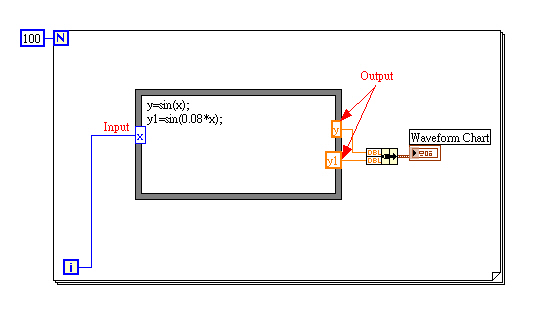
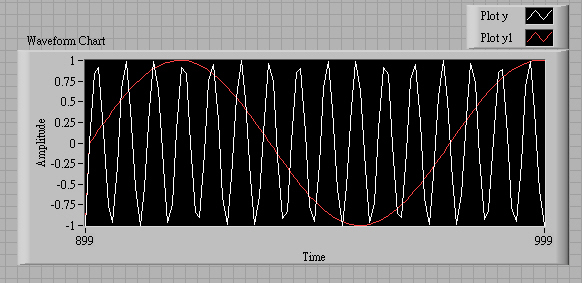
相信這樣應該比較明瞭了ㄅ
**Formula Node想關的語法資料:
Performing Conditional Statements Using Formula Nodes**
1 | if (y==x && a[2][3]<a[0][1]) { |
Performing Do Loops Using Formula Nodes
1 | do { |
Performing For Loops Using Formula Nodes
1 | for (y=5; y<x; y*=2) { |
Performing Switch Statements in Formula Nodes
1 | switch(month){ |
Performing While Loops Using Formula Nodes
1 | while (y!=x && a[2]>=a[0]) { |
Precedence of Operators in Formula Nodes and Expression Nodes
| ** | exponentiation |
| +, -, !, ~, ++, and –– | unary plus, unary negation, logical not, bit complement, pre- and post-increment, pre- and post-decrement ++ and –– are not available in Expression Nodes. |
| *, /, % | multiplication, division, modulus (remainder) |
| + and – | addition and subtraction |
| >> and << | arithmetic shift right and shift left |
| >, <, >=, and <= | greater, less, greater or equal, and less or equal |
| != and == | inequality and equality |
| & | bit and |
| ^ | bit exclusive or |
| && | logical and |
| ? : | conditional evaluation |
| = op= | assignment, shortcut operate and assign op can be +, –, *, /, >>, <<, &, ^, |
Formula Node and Expression Node Functions
| Function | Corresponding LabVIEW Function | Description |
|---|---|---|
| abs(x) | Absolute Value | Returns the absolute value of x. |
| acos(x) | Inverse Cosine | Computes the inverse cosine of x in radians. |
| acosh(x) | Inverse Hyperbolic Cosine | Computes the inverse hyperbolic cosine of x. |
| asin(x) | Inverse Sine | Computes the inverse sine of x in radians. |
| asinh(x) | Inverse Hyperbolic Sine | Computes the inverse hyperbolic sine of x. |
| atan(x) | Inverse Tangent | Computes the inverse tangent of x in radians. |
| atan2(y,x) | Inverse Tangent (2 Input) | Computes the arctangent of y/x in radians. |
| atanh(x) | Inverse Hyperbolic Tangent | Computes the inverse hyperbolic tangent of x. |
| ceil(x) | Round To +Infinity | Rounds x to the next higher integer (smallest integer > x). |
| ci(x) | Cosine Integral | Evaluates the cosine integral for any real nonnegative number x. |
| cos(x) | Cosine | Computes the cosine of x, where x is in radians. |
| cosh(x) | Hyperbolic Cosine | Computes the hyperbolic cosine of x. |
| cot(x) | Cotangent | Computes the cotangent of x (1/tan(x)), where x is in radians. |
| csc(x) | Cosecant | Computes the cosecant of x (1/sin(x)), where x is in radians. |
| exp(x) | Exponential | Computes the value of e raised to the x power. |
| expm1(x) | Exponential (Arg) – 1 | Computes one less than the value of e raised to the x power ((e^x) – 1). |
| floor(x) | Round To –Infinity | Truncates x to the next lower integer (largest integer <= x). |
| getexp(x) | Mantissa & Exponent | Returns the exponent of x. |
| gamma(x) | Gamma | Evaluates the gamma function or incomplete gamma function for x. |
| getman(x) | Mantissa & Exponent | Returns the mantissa of x. |
| int(x) | Round To Nearest | Rounds x to the nearest integer. |
| intrz(x) | — | Rounds x to the nearest integer between x and zero. |
| ln(x) | Natural Logarithm | Computes the natural logarithm of x (to the base of e). |
| lnp1(x) | Natural Logarithm (Arg +1) | Computes the natural logarithm of (x + 1). |
| log(x) | Logarithm Base 10 | Computes the logarithm of x (to the base of 10). |
| log2(x) | Logarithm Base 2 | Computes the logarithm of x (to the base of 2). |
| max(x,y) | Max & Min | Compares x and y and returns the larger value. |
| min(x,y) | Max & Min | Compares x and y and returns the smaller value. |
| mod(x,y) | Quotient & Remainder | Computes the remainder of x/y, when the quotient is rounded toward –Infinity. |
| pow(x,y) | Power of X | Computes x raised to the y power. |
| rand( ) | Random Number (0 – 1) | Produces a floating-point number between 0 and 1 exclusively. |
| rem(x,y) | Quotient & Remainder | Computes the remainder of x/y, when the quotient is rounded to the nearest integer. |
| si(x) | Sine Integral | Evaluates the sine integral for any real number x. |
| sec(x) | Secant | Computes the secant of x, where x is in radians (1/cos(x)). |
| sign(x) | Sign | Returns 1 if x is greater than 0, returns 0 if x is equal to 0, and returns –1 if x is less than 0. |
| sin(x) | Sine | Computes the sine of x, where x is in radians. |
| sinc(x) | Sinc | Computes the sine of x divided by x (sin(x)/x), where x is in radians. |
| sinh(x) | Hyperbolic Sine | Computes the hyperbolic sine of x. |
| sizeOfDim(ary,di) | — | Returns the size of the dimension di specified for the array ary. |
| spike(x) | Spike | Generates the spike function for any real number x. |
| sqrt(x) | Square Root | Computes the square root of x. |
| step(x) | Step | Generates the step function for any real number x. |
| tan(x) | Tangent | Computes the tangent of x, where x is in radians. |
| tanh(x) | Hyperbolic Tangent | Computes the hyperbolic tangent of x. |
本部落格所有文章除特別聲明外,均採用CC BY-NC-SA 4.0 授權協議。轉載請註明來源 X Workshop|量測自動化 × 嵌入式 × AI 開發實戰!